

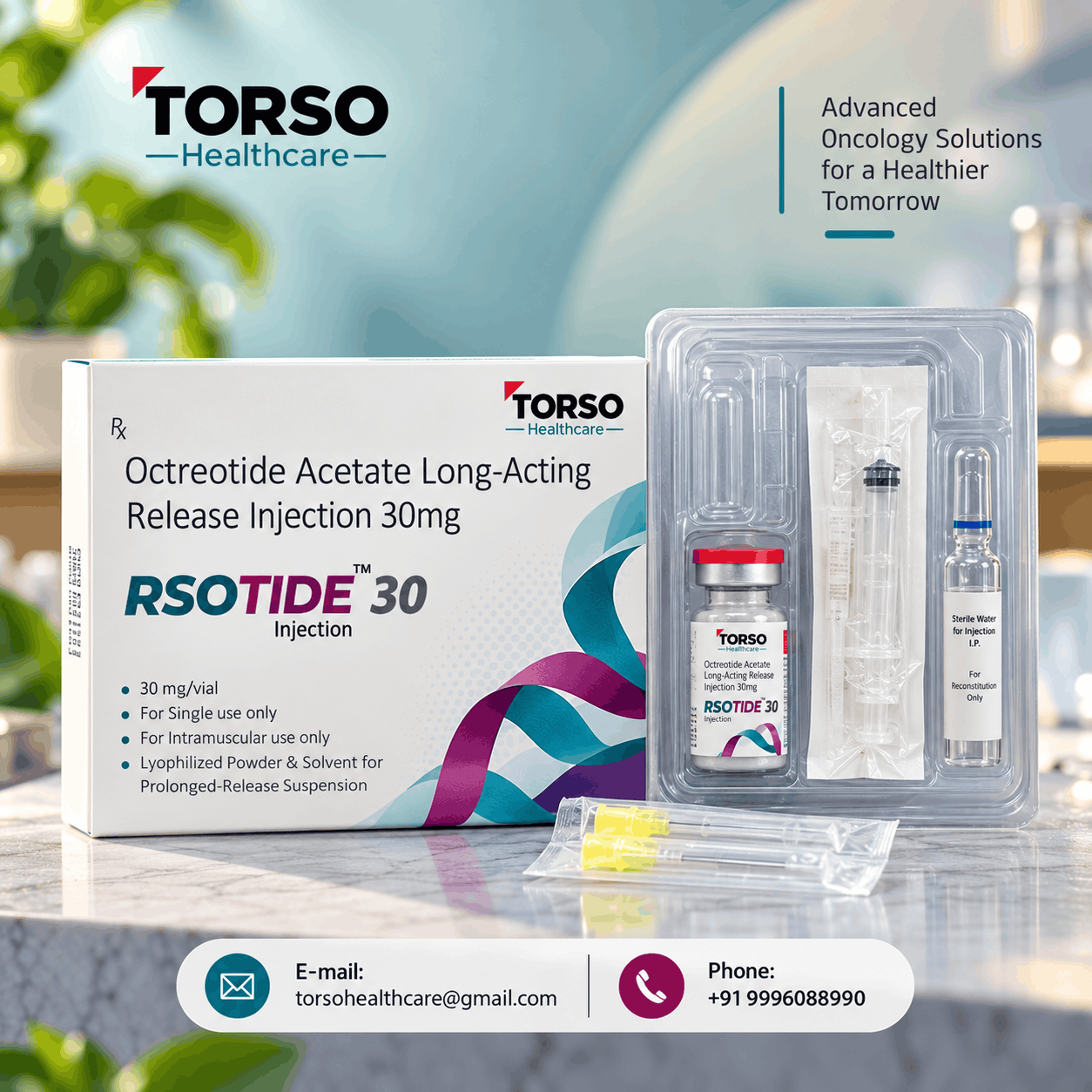
Octreotide Acetate Long-Acting Release Injection 30mg
₹22,000.00 Original price was: ₹22,000.00.₹20,000.00Current price is: ₹20,000.00.
| Specification | Details |
| Product Name | Octreotide Acetate Long-Acting Release Injection 30mg |
| Composition | Octreotide 30 mg, expressed as octreotide acetate, as a microsphere depot supplied with solvent |
| Packaging Size | Single dose kit, one vial with 2 mL solvent, adapter, and safety needle |
| Packaging Type | 6 mL glass vial with 3 mL prefilled solvent syringe, vial adapter, and safety needle |
| Brand Name | RSOTIDE 30 Injection |
| Form | Powder and diluent for suspension for injection |
| Strength | Octreotide 30 mg per vial, the highest marketed strength |
| Shelf Life | 36 months |
| Usage | Acromegaly, and symptom control in metastatic carcinoid tumors and VIPomas, after an inadequate response at 20 mg |
| Route of Administration | Deep intramuscular, gluteal only, once every 4 weeks |
| Storage | Refrigerated at 2 to 8°C, protected from light, do not freeze |
| Certification | WHO-GMP, ISO, DCGI |
| Supply & Export | Available for the domestic and international markets |
| Manufacturer Name | Torso Healthcare |
| Country of Origin | Baddi, Himachal Pradesh (Made in India) |
Octreotide Acetate Long-Acting Release Injection 30mg
₹22,000.00 Original price was: ₹22,000.00.₹20,000.00Current price is: ₹20,000.00.
| Specification | Details |
| Product Name | Octreotide Acetate Long-Acting Release Injection 30mg |
| Composition | Octreotide 30 mg, expressed as octreotide acetate, as a microsphere depot supplied with solvent |
| Packaging Size | Single dose kit, one vial with 2 mL solvent, adapter, and safety needle |
| Packaging Type | 6 mL glass vial with 3 mL prefilled solvent syringe, vial adapter, and safety needle |
| Brand Name | RSOTIDE 30 Injection |
| Form | Powder and diluent for suspension for injection |
| Strength | Octreotide 30 mg per vial, the highest marketed strength |
| Shelf Life | 36 months |
| Usage | Acromegaly, and symptom control in metastatic carcinoid tumors and VIPomas, after an inadequate response at 20 mg |
| Route of Administration | Deep intramuscular, gluteal only, once every 4 weeks |
| Storage | Refrigerated at 2 to 8°C, protected from light, do not freeze |
| Certification | WHO-GMP, ISO, DCGI |
| Supply & Export | Available for the domestic and international markets |
| Manufacturer Name | Torso Healthcare |
| Country of Origin | Baddi, Himachal Pradesh (Made in India) |
Nobody starts here. Octreotide Acetate Long-Acting Release Injection 30mg is a strength patients arrive at after a review, and that single fact changes how it gets bought, stocked, and forecast. The labeling puts almost everyone on 20 mg first, holds them there for two or three months, depending on the condition, then reads the result and decides. Only the patients whose response falls short move up. Demand for this vial therefore tracks a clinical decision rather than a headcount, which makes it the harder of the two strengths to plan and the one more often out of stock.
How a Patient Arrives at 30 mg
The route to this vial is written into the dosing section, and it differs by condition in a way that matters to anyone planning supply. Acromegaly is judged on numbers. Two blood markers, growth hormone and IGF-1, are read alongside symptoms after three months, and the thresholds are explicit. Carcinoid syndrome and VIPomas are judged on how the patient feels after two months, with no laboratory cutoff at all.
| At the review | Acromegaly | Carcinoid tumors and VIPomas |
| When the review happens | After 3 months at 20 mg | After 2 months at 20 mg |
| What the decision rests on | Growth hormone and IGF-1 blood levels, plus symptoms | Symptom control alone, with no numeric threshold |
| Drop to 10 mg when | GH at or below 1 ng per mL, IGF-1 normal, and symptoms controlled | Symptoms are well controlled, as a trial, returning to 20 mg if they recur |
| Hold at 20 mg when | GH at or below 2.5 ng per mL, IGF-1 normal, and symptoms controlled | Symptoms stay adequately controlled |
| Move to 30 mg when | GH above 2.5 ng per mL, IGF-1 raised, or symptoms uncontrolled | Symptoms are not adequately controlled |
| Above 30 mg | May go to 40 mg every 4 weeks, and no higher | 30 mg every 4 weeks is the maximum |
Read the bottom row twice, because it is the most commercially useful line in the table. For carcinoid tumors and VIPomas, 30 mg every four weeks is the maximum recommended dose. There is nothing above it in the labeling. A patient who is not controlled at 30 mg has run out of licensed depot options, and the clinician moves to a different approach rather than a bigger vial.
For Carcinoid Patients, 30 mg Is the Ceiling
Acromegaly has one more step. If growth hormone, IGF-1, or symptoms stay uncontrolled at 30 mg, the labeling allows an increase to 40 mg every four weeks, and states that doses above 40 mg are not recommended. Worth noting for anyone building a product file: 40 mg is a dose, not a marketed vial. The depot is made in 10 mg, 20 mg, and 30 mg, so a 40 mg dose is assembled from the strengths that exist.
The labeling also covers what happens between injections. A carcinoid or VIPoma patient with breakthrough symptoms may be given the subcutaneous injection for a few days at their previous dose, stopped once control returns. That is a second reason a supplier serving these patients holds both presentations, and it applies at 30 mg just as it does at the 20 mg depot strength. Buyers assembling a neuroendocrine range usually plan this next to the supportive oncology lines they already stock, such as leucovorin calcium injection.
What Octreotide Acetate Long-Acting Release Injection 30mg Treats
The indications are the same across all three strengths, and the strength is a dosing decision made inside them rather than a separate license. Acromegaly covers long-term maintenance for patients who responded inadequately to surgery or radiotherapy, or for whom neither is an option. In metastatic carcinoid tumors, the labeled target is long-term treatment of the severe diarrhea and flushing episodes. In VIP secreting tumors, it is the profuse watery diarrhea. The tumor itself is managed separately.
What separates the Octreotide Acetate Long-Acting Release Injection 30mg uses from the lower strengths is the patient history behind them. Everyone receiving this vial has already taken the depot for at least two months and has already been assessed once. Nobody arrives here untreated, which is a different clinical profile from an acute cytotoxic vial such as carboplatin 600 mg vial that may be given on day one of a regimen.
What the Extra 10 mg Changes
Less than a buyer might assume, and the direction is not what most people expect. Adverse reaction rates across the three strengths in the carcinoid study do not climb in a straight line. Nausea was reported less often at 30 mg than at 10 mg. Headache was highest in the middle of the range. Only flatulence and injection site pain rose with dose in the way intuition suggests.
| Reported in the carcinoid study | 10 mg | 20 mg | 30 mg |
| Nausea | 40.9% | 30.0% | 24.0% |
| Abdominal pain | 35.4% | 10.0% | 20.0% |
| Headache | 18.2% | 30.0% | 16.0% |
| Flatulence | 9.1% | 10.0% | 16.0% |
| Injection site pain, acromegaly | 2% | 9% | 11% |
Injection site pain is the one reliable dose effect, and it has a physical explanation. More drugs mean more microsphere material going into the same muscle through the same needle. In acromegaly patients, it rose from 2 percent at 10 mg to 11 percent at 30 mg, and in carcinoid patients, it ran higher still. That is worth putting in training material, because a patient who was comfortable at 20 mg may report something new after the step up and assume the product changed.
Everything else is identical. The kit holds the same 6 mL single-dose vial, the same 2 mL prefilled diluent syringe, the same vial adapter, and the same 1.5-inch 19-gauge safety needle. The depot is the same poly(DL-lactide-co-glycolide) and mannitol system at every strength, with the solvent carrying carmellose sodium, mannitol, poloxamer 188, and water for injections. Storage stays at 2 to 8°C protected from light. The kit still stands at room temperature for 30 to 60 minutes before preparation. The route is still deep gluteal intramuscular and never intravenous, and the suspension is still given immediately after mixing. Those handling rules are covered in full in the injection manufacturers in India overview and apply unchanged to every strength.
Octreotide 30mg Injection Side Effects
Gastrointestinal effects lead, as they do at every strength. Across the acromegaly studies, diarrhea, abdominal pain, and flatulence were the most frequently reported, with diarrhea occurring in more than a third of patients and reaching 47.4 percent among patients new to treatment. Most of it settles as therapy continues, which is the expected result of suppressing a hormone that regulates gut secretion.
Gallstones are the finding that changes how a patient is followed. Just over half of acromegaly patients, 52 percent, developed new biliary abnormalities, and 22 percent formed new gallstones. Among carcinoid patients, the figure for new gallstones was 24 percent. European labeling therefore sets gallbladder ultrasound before treatment and at roughly six-monthly intervals during it, and that schedule does not relax at the higher strength.
Two further Octreotide Acetate Long-Acting Release Injection 30mg side effects belong beside them. Blood glucose moves in both directions, with hyperglycemia around 15 percent in acromegaly patients and 27 percent in carcinoid patients, so glucose is checked when treatment starts and whenever the dose changes. A step from 20 mg to 30 mg is a dose change, so that check applies at exactly the point this vial enters the picture. Thyroid function is assessed at baseline and periodically during long-term use.
Forecasting 30 mg Demand Against 20 mg
This is where the strength gets mishandled. A buyer who orders 10 mg, 20 mg and 30 mg in equal numbers will sit on the wrong stock within a quarter, because the three are not drawn in equal proportion. The labeling makes 20 mg the entry point for both main indications, so it carries the volume. The 10 mg covers dialysis and cirrhosis patients at the start, plus patients stepped down after good control. The 30 mg covers patients escalated at the review.
The honest answer about the ratio is that it depends on the treating centers you supply, and no published figure fixes it. What can be said from the labeling is the direction: every patient passes through 20 mg, and only some reach 30 mg. Build the first order around that and correct it against your own pull in the second quarter rather than guessing a split now.
Octreotide LAR 30mg Price
The Octreotide Acetate Long-Acting Release Injection 30mg price is MRP ₹ 20,000 per kit. Presentation is what moves it, because this product ships as a kit rather than a bare vial. The vial, the prefilled diluent syringe, the vial adapter, and the safety needle all sit inside that figure, so a change to any one of them changes the quote.
Refrigerated handling adds to it on every consignment, since the depot holds 2 to 8°C from the plant through to the clinic. Batch pricing then depends on the number of kits. Send your monthly requirement for octreotide LAR 30 mg, with the kit format and the destination market, and the team will come back with current rates.
Octreotide LAR 30mg Manufacturer and Supply Terms
Torso Healthcare is a WHO GMP-certified injectable manufacturer based in Baddi, Himachal Pradesh, supplying hospitals, distributors, and franchise partners in India and export markets from its injectable manufacturing unit. Buyers searching for an Octreotide Acetate Long-Acting Release Injection 30mg manufacturer in India usually want the same three answers as at the lower strength: whether the depot is produced in-house, how release consistency is demonstrated between batches, and what cold chain commitment travels with a consignment. The higher fill does not change any of those questions.
Dossier support, batch documentation, and own label supply terms are shared on request, on the same footing offered to PCD franchise partners.
Hospitals, distributors, and franchise partners sourcing Octreotide Acetate Long-Acting Release Injection 30mg in bulk, or adding the escalation strength to an existing depot line, can share your requirement with the quantity, kit format, and destination market, and Torso Healthcare will reply with current rates and lead times.
Dose adjustment rules, indications, kit contents, storage, and safety data on this page follow the Sandostatin LAR prescribing information and the DailyMed product label.
Frequently Asked Questions
Why is 30 mg not used as a starting dose?
Because the labeling sets 20 mg as the start for both main indications and reviews the response before going higher. Acromegaly is reviewed after three months on blood markers and symptoms, carcinoid and VIPoma after two months on symptoms alone. Only an inadequate response moves a patient to 30 mg.
Is there a strength above 30 mg?
Not as a vial. For acromegaly, the labeling allows escalation to 40 mg every four weeks when 30 mg does not control the condition, assembled from the marketed strengths of 10, 20, and 30 mg. For carcinoid tumors and VIPomas, 30 mg every four weeks is the maximum recommended dose.
What happens if symptoms break through between injections?
The labeling allows the subcutaneous injection for a few days at the dose the patient was previously taking, stopped once symptoms come back under control. This is why a supplier serving carcinoid and VIPoma patients keeps the immediate-release presentation available alongside the depot.
Does the 30 mg kit differ from the lower strengths?
Only in the fill. The vial size, the 2 mL diluent syringe, the vial adapter, the safety needle, the storage conditions, and the preparation steps are the same across 10, 20, and 30 mg. Cartoning and labeling are what distinguish them on a shelf.
Does the price scale with the strength?
Not in proportion. Most of the cost sits outside the drug itself. Kit components, the refrigerated supply chain, the sterile microsphere process, and release testing cost roughly the same, whatever the fill weight, so a larger fill spreads those fixed costs further rather than multiplying them.
Can we take 30 mg on its own, without the other strengths?
Yes, though it is unusual. Most partners carry 20 mg as the volume line and hold 30 mg in smaller numbers for escalated patients. Taking 30 mg alone means a prescriber cannot start a patient from your range, so it works best as an addition to an existing supply rather than an entry point.
Disclaimer: This page is intended for pharmaceutical businesses, trade buyers, and healthcare professionals as product reference information only. It is not an advertisement to the public, not medical advice, and not a recommendation for treatment. Octreotide long-acting release injection is a prescription medicine and must be prescribed and administered only under qualified medical supervision.
Third Party Enquiry Form
Filling our enquiry form is the first step towards getting in touch with us. It helps us understand your requirements better and enables us to provide you with a personalized solution.
Third Party Enquiry Form
Filling our enquiry form is the first step towards getting in touch with us. It helps us understand your requirements better and enables us to provide you with a personalized solution.
Related Products
Related products
-
Sale!
Pemetrexed 100mg Injection
₹4,300.00Original price was: ₹4,300.00.₹3,800.00Current price is: ₹3,800.00. -
Sale!
Pemetrexed 500 mg Inj
₹4,500.00Original price was: ₹4,500.00.₹4,000.00Current price is: ₹4,000.00. -
Sale!
Octreotide Acetate Long-Acting Release Injection 20mg
₹20,000.00Original price was: ₹20,000.00.₹18,000.00Current price is: ₹18,000.00. -
Sale!
Doxorubicin 50mg (Doxorubicin Hydrochloride Injection IP 50mg)
₹4,100.00Original price was: ₹4,100.00.₹3,000.00Current price is: ₹3,000.00.