

Doxorubicin 50mg (Doxorubicin Hydrochloride Injection IP 50mg)
₹4,100.00 Original price was: ₹4,100.00.₹3,000.00Current price is: ₹3,000.00.
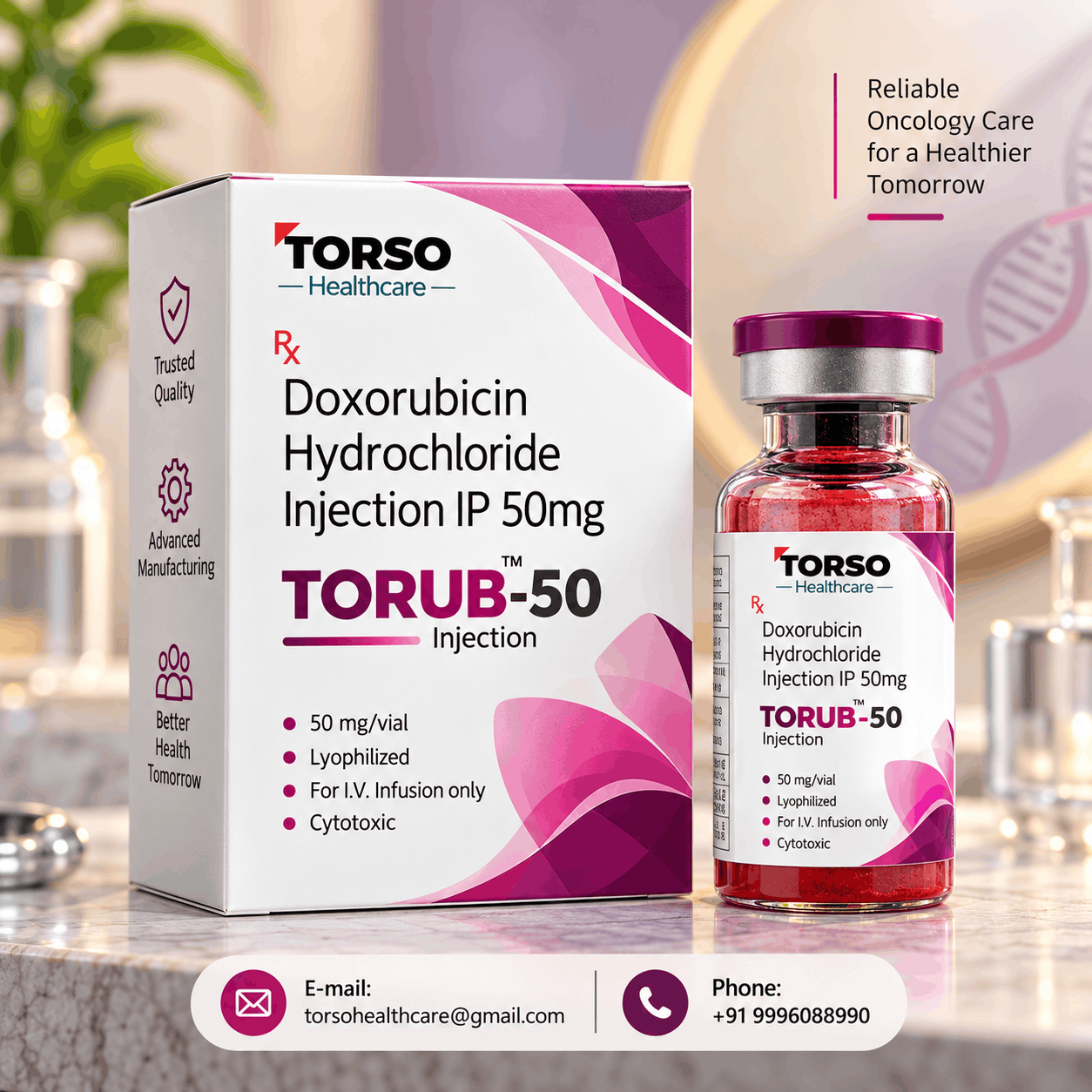
| Specification | Details |
| Product Name | Doxorubicin Hydrochloride Injection IP 50mg |
| Composition | Doxorubicin hydrochloride IP 50 mg per vial |
| Packaging Size | Single vial pack |
| Packaging Type | Amber glass vial with rubber stopper and flip-off seal |
| Brand Name | TORUB-50 Injection |
| Form | Lyophilized powder for injection, or 2 mg per mL solution |
| Strength | Doxorubicin hydrochloride 50 mg |
| Shelf Life | 24 months |
| Usage | Acute leukemia, lymphomas, soft tissue and osteogenic sarcomas, pediatric malignancies, and adult solid tumors, including breast and lung, as named in approved labeling |
| Route of Administration | Intravenous, through a free-flowing infusion line |
| Storage | Powder at 20 to 25°C, solution refrigerated at 2 to 8°C, both protected from light |
| Certification | WHO-GMP, ISO, DCGI |
| Supply & Export | Available for the domestic and international markets |
| Manufacturer Name | Torso Healthcare |
| Country of Origin | Baddi, Himachal Pradesh (Made in India) |
Doxorubicin 50mg (Doxorubicin Hydrochloride Injection IP 50mg)
₹4,100.00 Original price was: ₹4,100.00.₹3,000.00Current price is: ₹3,000.00.
| Specification | Details |
| Product Name | Doxorubicin Hydrochloride Injection IP 50mg |
| Composition | Doxorubicin hydrochloride IP 50 mg per vial |
| Packaging Size | Single vial pack |
| Packaging Type | Amber glass vial with rubber stopper and flip-off seal |
| Brand Name | TORUB-50 Injection |
| Form | Lyophilized powder for injection, or 2 mg per mL solution |
| Strength | Doxorubicin hydrochloride 50 mg |
| Shelf Life | 24 months |
| Usage | Acute leukemia, lymphomas, soft tissue and osteogenic sarcomas, pediatric malignancies, and adult solid tumors, including breast and lung, as named in approved labeling |
| Route of Administration | Intravenous, through a free-flowing infusion line |
| Storage | Powder at 20 to 25°C, solution refrigerated at 2 to 8°C, both protected from light |
| Certification | WHO-GMP, ISO, DCGI |
| Supply & Export | Available for the domestic and international markets |
| Manufacturer Name | Torso Healthcare |
| Country of Origin | Baddi, Himachal Pradesh (Made in India) |
Most medicines have a daily limit. This one has a limit for the rest of the patient’s life. Doxorubicin carries a cumulative ceiling of around 550 mg per square meter, and every milligram a patient has ever received counts toward it, including doses given years earlier at a different hospital. A vial of doxorubicin 50mg is therefore not a unit of stock in the ordinary sense. It is a withdrawal from an account the patient can never top up, and that single feature drives how the product is prescribed, recorded, and bought.
Every Vial Counts Against a Lifetime Ceiling
The risk the ceiling exists to control is heart failure, and the labeling gives the shape of the curve rather than a single cutoff. What stands out is where it bends.
| Cumulative dose reached | Reported risk of congestive heart failure |
| 300 mg per square meter | 1 to 2 percent |
| 400 mg per square meter | 3 to 5 percent |
| 450 mg per square meter | 5 to 8 percent |
| 500 mg per square meter | 6 to 20 percent |
Read the last two rows together. Between 450 and 500 mg per square meter, a span of one more partial cycle, the upper bound of the reported range moves from 8 percent to 20 percent. A separate retrospective review, which is a different data set and not part of that table, reported congestive heart failure in 7 percent of patients at 575 mg per square meter and 21 percent at 728. The ceiling is not a formality that clinicians walk past.
Worked example, to turn the figure into vials. Take a reference body surface area of 1.7 square meters and the 550 mg per square meter ceiling. That patient has a lifetime allowance of roughly 935 mg. A common single-agent doxorubicin dose is 60 to 75 mg per square meter every 21 days, so a 60 mg per square meter cycle uses about 102 mg, which is close to two 50 mg vials. The allowance covers somewhere near nine cycles in total. This is an illustration of how the ceiling converts into packs, not a dosing instruction, and the treating oncologist sets every real dose.
For a distributor, the practical consequence is record-keeping rather than storage. Pharmacies serving oncology units track cumulative anthracycline exposure per patient, so batch and quantity documentation on this product gets checked more carefully than on a companion agent such as carboplatin 150 mg, which carries no equivalent lifetime cap.
Doxorubicin Hydrochloride Mechanism of Action
The reason the ceiling exists sits inside the mechanism, which is unusual and worth following. Doxorubicin binds nucleic acids by slotting its anthracycline ring structure between the base pairs of the DNA double helix, a process the labeling describes as intercalation. It then interacts with topoisomerase II to form DNA cleavable complexes, and the labeling identifies that interaction as an important part of how the drug kills cells.
Here is the part that connects back to the heart. Enzymatic reduction of the molecule generates highly reactive species, including the hydroxyl free radical, and the labeling states that this free radical chemistry is implicated in cardiotoxicity. The same reactivity that makes the doxorubicin hydrochloride mechanism of action effective against tumor cells is what damages cardiac tissue over repeated exposure. That is why the limit is cumulative rather than per dose, and why no infusion schedule removes it.
Powder or Solution: Two Different Doxorubicin 50mg Vials
Here is the decision most buyers make by accident. At 50 mg, the product exists in two presentations that share a molecule, a strength, and a name, and share almost nothing else about how they travel. One is a lyophilized powder stored at room temperature. The other is 25 mL of a 2 mg per mL solution that has to stay refrigerated from the plant to the pharmacy.
| At 50 mg | Lyophilized powder | Solution |
| What is in the vial | Powder with lactose monohydrate | 25 mL at 2 mg per mL |
| Storage | 20 to 25°C, protected from light | 2 to 8°C refrigerated, protected from light |
| Cold chain on every consignment | Not required | Required |
| Step at the pharmacy | Reconstitution before dilution | Dilute and go |
| Where it suits | Long transport routes and warm regions | Centers with reliable refrigeration and high throughput |
Neither choice is better in the abstract. The powder needs a reconstitution step in a cytotoxic cabinet, which some pharmacies would rather avoid, while the solution removes that step and adds a cold chain cost to every consignment. For export routes and for centers in regions where refrigerated transport is unreliable, the powder usually wins, and the same reasoning runs through any injectable manufacturing process decision where a lyophilizer adds cost at the plant and removes cost in the field.
Doxorubicin Hydrochloride Uses
The range is unusually wide, which is why this molecule has stayed in regimens for decades. European labeling lists acute leukemia, lymphomas, soft tissue and osteogenic sarcomas, pediatric malignancies, and adult solid tumors, with breast and lung carcinomas named specifically. It is almost always given as part of a combination regimen rather than alone.
One clarification belongs on any supplier page, because the drug class misleads people. Doxorubicin is an anthracycline antibiotic by chemical class, and the labeling states plainly that it cannot be used as an antibacterial agent. The Doxorubicin hydrochloride injection IP 50mg uses are cytotoxic uses only. In practice, the vial travels with the rest of a regimen, which is why buyers stocking it usually carry docetaxel injection and a gemcitabine 1 g vial in the same order.
On dosing, the labeling gives 60 to 75 mg per square meter as a single agent every 21 days, with the lower end for patients whose marrow reserve is reduced. In combination, the common range is 40 to 60 mg per square meter every 21 to 28 days. Dose also falls with liver function: a plasma bilirubin of 1.2 to 3.0 mg per dL calls for a 50 percent reduction, and 3.1 to 5.0 mg per dL calls for 75 percent.
Doxorubicin Hydrochloride Side Effects and the Boxed Warnings
Five warnings sit at the top of the labeling, and each one changes something about how the product is handled rather than simply describing a risk:
- Severe local tissue necrosis will occur if the drug extravasates during administration.
- Myocardial toxicity, in its most severe form, potentially fatal congestive heart failure, may occur.
- Secondary acute myelogenous leukemia and myelodysplastic syndrome have been reported.
- Severe myelosuppression may occur.
- Dosage must be reduced in patients with impaired hepatic function.
Beyond those, the Doxorubicin hydrochloride injection IP 50mg side effects follow the pattern of a potent cytotoxic. Blood counts fall and are monitored through each cycle. Nausea, vomiting, mucositis, and hair loss are common. Urine turns red for one to two days, which alarms patients who were not told to expect it and costs a nurse a phone call that a line on the patient leaflet would have prevented.
Extravasation and the Blood Return Trap
This is the warning that catches experienced staff, so it is worth stating precisely. European labeling advises against a direct push injection because of extravasation risk, and adds that extravasation may occur even in the presence of adequate blood return. Pulling back and seeing blood in the line is the standard reassurance check at the cannula, and on this drug, it does not settle the question.
Doxorubicin is a vesicant, so a leak into tissue produces necrosis rather than irritation. The practical answer is administration into the tubing of a freely running intravenous infusion with the site watched throughout, and a written extravasation procedure available on the unit before the first dose is given. Any training material shipped with the product should carry that procedure rather than assume it.
Doxorubicin Hydrochloride Injection IP 50mg Price
The Doxorubicin hydrochloride injection IP 50mg price is MRP ₹3,000 per vial. Presentation is what moves it most, because the lyophilized powder and the 2 mg per mL solution do not cost the same to supply. The solution needs refrigerated transport on every consignment, and the powder does not, so the two are quoted separately rather than as one line.
Batch pricing then depends on the number of packs. Cytotoxic handling at the plant sits in the cost base as well, since containment, dedicated areas, and operator protection apply from dispensing through to packing. Send your monthly requirement for doxorubicin 50mg, with the presentation and pack size you need, and the team will come back with current rates.
Doxorubicin Hydrochloride Injection IP 50mg Manufacturer in India
Torso Healthcare is a WHO GMP-certified injectable manufacturer based in Baddi, Himachal Pradesh, among the pharma companies in Baddi supplying hospitals, distributors, and franchise partners across India and export markets. Cytotoxic products sit apart from the general injectable range because containment and operator protection apply from dispensing through to packing. Buyers assessing a Doxorubicin hydrochloride injection IP 50mg manufacturer in India usually ask which presentation is made, how containment is handled, and what batch documentation arrives with a consignment.
Facility details and batch documentation for the wider oncology product range are shared on request, along with standard contract manufacturing terms.
Hospitals, distributors, and franchise partners sourcing doxorubicin 50mg in bulk, or adding it to their own label oncology line, can send the specification with the presentation, quantity, and destination market, and Torso Healthcare will reply with current rates and lead times.
Cumulative dose figures, mechanism, dosing, hepatic adjustment, presentations, storage, and safety data on this page follow the FDA prescribing information and the European summary of product characteristics.
Frequently Asked Questions
Why does doxorubicin have a lifetime dose limit?
Because the damage to the heart muscle accumulates and does not reverse between cycles. Reported heart failure risk climbs from 1 to 2 percent at 300 mg per square meter to 6 to 20 percent at 500. Doses given years ago at another hospital still count, so prescribers track exposure across a patient’s whole treatment history.
Is the powder vial interchangeable with the solution vial?
Both deliver the same 50 mg, and they are not interchangeable in a supply chain. The powder sits at 20 to 25°C and needs reconstitution. The solution is 25 mL at 2 mg per mL and must stay between 2 and 8°C. A tender written for one presentation of doxorubicin 50mg and filled with the other creates a storage problem on arrival.
Why does urine turn red after treatment?
The drug itself is deep red, and it is excreted partly in urine. The labeling notes that urine may appear red for one to two days after administration. It is expected; it is not blood, and patient information should say so, because an unwarned patient often assumes the worst.
Can doxorubicin be used as an antibiotic?
No. It belongs to the anthracycline antibiotic class by chemistry, and the labeling states directly that it cannot be used as an antibacterial agent. The classification describes where the molecule came from rather than what it treats.
What documentation travels with a cytotoxic consignment?
A certificate of analysis per batch, with manufacturing and expiry details, and the storage condition stated on the carton. Cytotoxic products also need packaging that survives transit intact, since a broken vial is a containment incident rather than a stock loss.
Can the vial be supplied under our own brand?
Yes, subject to the product being in the current manufacturing range. Own label supply covers brand name and carton artwork for both third-party manufacturing and franchise arrangements, with batch documentation sent on every consignment.
Disclaimer: This page is intended for pharmaceutical businesses, trade buyers, and healthcare professionals as product reference information only. It is not an advertisement to the public, not medical advice, and not a recommendation for treatment. Doxorubicin hydrochloride is a prescription cytotoxic medicine and must be prescribed and administered only under qualified medical supervision.
Third Party Enquiry Form
Filling our enquiry form is the first step towards getting in touch with us. It helps us understand your requirements better and enables us to provide you with a personalized solution.
Third Party Enquiry Form
Filling our enquiry form is the first step towards getting in touch with us. It helps us understand your requirements better and enables us to provide you with a personalized solution.
Related Products
Related products
-
Sale!
Octreotide Acetate Long-Acting Release Injection 30mg
₹22,000.00Original price was: ₹22,000.00.₹20,000.00Current price is: ₹20,000.00. -
Sale!
Pemetrexed 500 mg Inj
₹4,500.00Original price was: ₹4,500.00.₹4,000.00Current price is: ₹4,000.00. -
Sale!
Pemetrexed 100mg Injection
₹4,300.00Original price was: ₹4,300.00.₹3,800.00Current price is: ₹3,800.00. -
Sale!
Ifosfamide Injection (Ifosfamide for Injection IP 1gm with Mesna Injection)
₹1,000.00Original price was: ₹1,000.00.₹838.00Current price is: ₹838.00.