
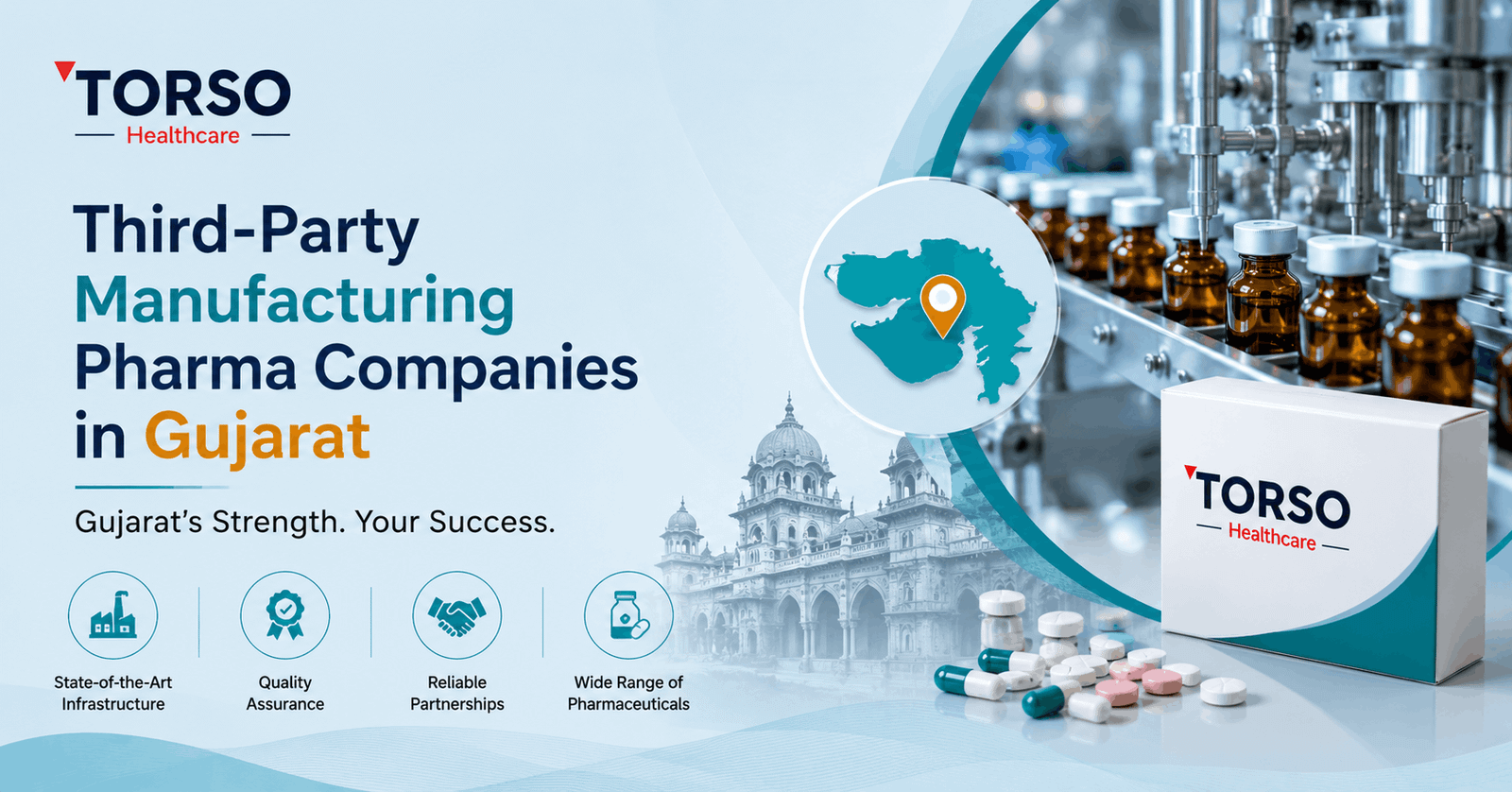
Most brand owners start the same way. A spreadsheet of forty supplier names, every website claiming the same certifications, and no way to tell which three deserve an email. This page cuts that list down. Below are ten third party manufacturing pharma companies in Gujarat, the license work you need to finish first, and a worked example showing what a first order actually costs and how long it takes to reach your warehouse.
One thing to note up front. The list covers manufacturers with units inside the state as well as established plants that supply Gujarat brands from elsewhere in India. Both are normal in this market, and what decides fit is the license and the production block rather than the pin code on the invoice.
In short, third party manufacturing pharma companies in Gujarat make finished, packed medicines for brand owners under the brand owner’s name and license. The brand keeps control of pricing, marketing, and distribution while the plant handles production, testing, and packaging. It removes the cost of building a factory and is the fastest route for a new brand to reach the market.
How This Shortlist Was Built
Four filters were applied when picking the third party manufacturing pharma companies in Gujarat, named below.
- A valid manufacturing license, verifiable against the CDSCO or state FDA record, rather than a logo on a homepage.
- GMP or WHO-GMP certification for the specific block your product would run in. A plant can be certified for oral solids and hold nothing suitable for a sterile product.
- At least three years of continuous operation. New units can be excellent, but a brand placing a first order has no easy way to check a track record that does not yet exist.
- Willingness to work with small and mid-sized brands. Several of the largest names in the state run superb facilities and will only quote at volumes a launching brand cannot commit to.
Certification claims below reflect publicly available company information. Verify them directly before you sign anything, which is a point returned to further down this page.
Top 10 Third Party Manufacturing Pharma Companies in Gujarat Worth Shortlisting
1. Torso Healthcare
| Serves | Gujarat and pan-India |
| Certifications | WHO, GMP, ISO 9001, ISO 22000, Organic |
| Forms handled | Tablets, capsules, softgels, syrups, injections, IV infusions, ointments |
| Categories | Pharmaceuticals, nutraceuticals, herbal, cosmetics |
| Good fit for | Brands running more than one product category under one supplier |
Six dosage forms and four product categories sit under the same arrangement, which matters when your range mixes prescription products with nutraceutical or herbal lines. Most contract units handle one or the other. Injectable and IV infusion depth is the stronger side of the catalog, covering anticoagulants, oncology molecules, and hospital antibiotics, with sterile injectable production run as a dedicated capability rather than an add-on. Ready-stock divisions are also available for brands taking the franchise route instead.
2. Lincoln Pharmaceuticals
| Serves | Gujarat and pan-India |
| Certifications | GMP-compliant, export approvals across several markets |
| Forms handled | Tablets, capsules, liquids, injectables, and veterinary formulations |
| Known for | Human and veterinary production under one roof |
| Good fit for | Brands wanting scale plus export documentation support |
A listed Ahmedabad company with decades of production behind it. The veterinary capability sets it apart from most of this list, so a brand running both human and animal health ranges can consolidate suppliers. Expect volume expectations to sit higher than a smaller contract unit would ask for.
3. Cataliq Laboratories
| Serves | Gujarat and pan-India |
| Certifications | WHO-GMP, GMP, ISO |
| Forms handled | Tablets, capsules, dry syrups, nutraceuticals |
| Known for | Beta-lactam antibiotics across the penicillin and cephalosporin groups |
| Good fit for | Antibiotic ranges need segregated blocks |
The plant sits on the Dholka to Ahmedabad highway at Bareja. Beta-lactam work needs physically separate facilities under Indian rules, and cephalosporins need separation again from penicillins, so a unit already holding both approvals saves you a long search. Veterinary and nutraceutical capabilities are also in place.
4. Accuwell Medics
| Serves | Gujarat and pan-India |
| Certifications | WHO-GMP |
| Forms handled | Tablets, capsules, beta-lactam range, nutraceuticals, ayurvedic products |
| Known for | Dedicated blocks per product category |
| Good fit for | Brands running mixed allopathic and ayurvedic portfolios |
Focused specifically on contract work rather than treating it as a side business, which usually shows up in how fast a quotation arrives. The separate ayurvedic block matters when you plan an AYUSH range, because that sits under a different licensing route entirely.
5. MAAN Pharmaceuticals
| Serves | Gujarat and pan-India |
| Certifications | WHO-GMP |
| Forms handled | Small volume injectables, tablets, capsules |
| Known for | Ampoule and vial production |
| Good fit for | Anti-malarial, haematinic, and gastro injectable ranges |
The production facility is at Mehsana. Catalog depth covers arteether, chloroquine phosphate, iron sucrose, and menadione injections alongside oral esomeprazole and omeprazole. A practical option when your range mixes a few injectables with oral support products.
6. Concord Biotech
| Serves | Gujarat and international markets |
| Certifications | Multiple regulated market approvals |
| Forms handled | Active pharmaceutical ingredients, finished formulations |
| Known for | Fermentation-based API production |
| Good fit for | Brands needing API supply or complex molecule access |
This one sits at a different level from most contract units. Fermentation-derived immunosuppressants and oncology molecules are the core strength. Relevant when you need API sourcing rather than tablet packing, and worth knowing about even if it is outside your current scale.
7. Troikaa Pharmaceuticals
| Serves | Gujarat and pan-India |
| Certifications | GMP compliant, export approvals in place |
| Forms handled | Injectables, tablets, topicals |
| Known for | Differentiated injectable formulations |
| Good fit for | Brands wanting a technically stronger product story |
Based in Bodakdev, Ahmedabad. The reputation rests on formulation development rather than plain generics, which becomes useful when you want a product that a hundred competitors are not already selling on the same strength and pack.
8. Centcure Lifesciences
| Serves | Gujarat and pan-India |
| Certifications | WHO-GMP |
| Forms handled | Tablets, capsules, soft gelatin capsules, syrups |
| Known for | Soft gel capability |
| Good fit for | Nutraceutical and vitamin ranges |
Soft gel lines are less common than tablet lines. If your plan includes omega, vitamin D, or similar oil-filled products, this shortens the search considerably.
9. Nisarg Pharma
| Serves | Gujarat and pan-India |
| Certifications | GMP compliant |
| Forms handled | Tablets, capsules, syrups, nutraceuticals |
| Known for | Working with smaller brands |
| Good fit for | First-time brands and PCD businesses are testing a range |
Positioned towards flexibility rather than sheer volume, which is what most brands new to third party manufacturing pharma in Gujarat actually need on a first order.
10. Acron Pharmaceuticals
| Serves | Gujarat and pan-India |
| Certifications | GMP compliant |
| Forms handled | Tablets, capsules, liquids |
| Known for | Long operating history in the state |
| Good fit for | Steady repeat production of established generics |
Not the flashiest option on this list, and that is rather the point. For a brand with settled products and predictable monthly offtake, consistency beats novelty every time.
Licenses and Paperwork to Finish Before You Order
This is where most first-time brands lose six weeks. None of the third party pharma manufacturers in Gujarat can supply you until your own paperwork is in order, and the sequence matters.
What You Need in Your Own Name
- Drug marketing license. Issued by your state drug control authority. The manufacturer holds the manufacturing license, and you hold the marketing one. Any supplier who says this is optional is worth walking away from.
- GST registration, which you need before any tax invoice can be raised.
- Trademark application for the brand name. File before printing artwork, not after. Rebranding a product already in the market costs far more than the application fee.
- FSSAI license instead of a drug license when your range is nutraceutical rather than pharmaceutical. Different route, different authority, and the two are not interchangeable.
What the Manufacturer Must Hold
- A current manufacturing license covering your dosage form.
- Product permission for your exact composition and strength. Approval for cefixime 50mg does not extend to 100mg.
- The correct segregated block. Beta-lactam production is physically separated by law, and cephalosporins are distinct from penicillins.
What the Two of You Agree Between Yourselves
- Who owns the stability data, and whether you receive a copy.
- Confirmation in writing that the brand name stays in your name.
- A price revision clause with a defined notice period, agreed before the first order rather than after an API price spike.
Run all three groups in parallel rather than in sequence, and you take weeks off the launch date.
What a First Order Looks Like, Start to Finish
Worth setting expectations here, because this is where new brands are most often caught out.
These are batch manufacturers. Production runs at the batch level, and the batch size is set by the equipment, not by negotiation. A compression line configured for a given blend will run that blend, whether you asked for that quantity or not. Nobody in this market packs a few hundred units as a trial. Plan your working capital around a full batch per SKU and keep the SKU count low on a first order, rather than spreading a token quantity across a long product list.
One-time costs on top of the per-unit rate
- Artwork, plate, and cylinder charges: roughly Rs 8,000 to Rs 25,000 per SKU.
- New tablet tooling, where your pack or shape needs it: Rs 15,000 to Rs 40,000.
- Accelerated stability study, when the plant does not already hold data for that composition: Rs 25,000 to Rs 60,000.
Timeline for a First Order
| Stage | Typical duration |
| Quotation | 2 to 4 working days |
| Agreement and artwork approval | 1 to 2 weeks |
| Product permission from the state FDA, if not already held | 3 to 8 weeks |
| Production and quality control release | 3 to 5 weeks |
| Road dispatch to Gujarat | 2 to 4 days |
That puts a realistic first order at ten to fourteen weeks from first email to stock in hand, or six to eight weeks when the plant already holds permission for your composition. Repeat orders of the same SKU drop to four to six weeks, because the license work, artwork, and stability data are already done.
Take a Surat brand launching cefixime 100mg dry syrup in a 30ml pack. Budget around Rs 30,000 in one-time setup across artwork and plates, a three-month runway before launch, and a repeat cycle short enough to reorder before stock runs dry. Treat every figure here as indicative. API prices move, and a quotation given in March may not hold in September.
If a full batch commitment is more than you want to carry on a first launch, the PCD franchise route starts far smaller, though you give up brand ownership in exchange.
Checks to Run Before You Sign Anything
- Verify the manufacturing license number against the CDSCO or state FDA record. A scanned certificate on its own is not proof.
- Confirm the product permission covers your exact composition and strength.
- Ask when the last GMP audit took place and which authority conducted it. A confident answer arrives quickly.
- Check the block, not the plant. A general oral solid facility cannot legally run your antibiotic.
- Ask who holds the stability data and whether you received a copy. If you ever change suppliers, this decides whether you start over.
- Get the price revision clause in writing, with the notice period stated.
- Ask what happens commercially when a batch fails quality control after production.
Questions Worth Asking on the First Call
- How many SKUs are you currently running for brands of my size?
- What is your standard batch size for this dosage form?
- Do you already hold product permission for this composition?
- What is your current lead time from purchase order to dispatch?
- Who handles the e-way bill and freight, and is that inside or outside your quoted rate?
- Which markets are you already exporting to, if export is part of my plan?
- Can you supply a sample batch document set before I commit?
What Torso Healthcare Can Produce for You
Four product categories and six dosage forms, all under documented processes with full batch records handed over:
- Pharmaceuticals across tablets, capsules, syrups, and sterile injectables, including the IV infusion range, are built for hospital and institutional supply.
- Nutraceuticals, with softgel capsule production for oil-filled formats alongside standard tablets and capsules.
- Herbal products under the AYUSH route are kept separate from the allopathic lines.
- Cosmetics, including ointment and cream formats for topical ranges.
WHO, GMP, ISO 9001, ISO 22000, and Organic certifications are in place, and supply reaches Ahmedabad, Surat, Vadodara, and Rajkot on the same terms as the rest of India.
Send across your composition list and required volumes, and you will receive a costed quotation with lead times within 4 working days. Start the conversation here. Among the third party manufacturing pharma companies in Gujarat, brands are shortlisting this year; the ones worth your time are simply those that answer questions like these clearly and quickly.
Frequently Asked Questions
What is third party manufacturing in pharma?
You own the brand, the formula, and the market. A licensed plant manufactures the product for you under your brand name and hands over finished, packed stock. You avoid the capital cost of a plant while keeping full control of pricing and distribution.
Do I need my own drug license to place an order?
Yes. You need a drug marketing license in your own name before any manufacturer can supply branded stock to you. The manufacturer holds the manufacturing license, and you hold the marketing one.
How large does a third party pharma manufacturing order need to be?
Orders are placed at the batch level, and the batch size is set by the production equipment rather than by negotiation. These are bulk manufacturers, so plan for a full batch per SKU and keep the SKU count low on a first order instead of spreading a small quantity across many products.
How long does a first order take?
Plan for ten to fourteen weeks when the plant needs fresh product permission, and around six to eight weeks when that permission is already in place. Repeat orders of the same product usually run four to six weeks.
Is third party manufacturing different from a PCD franchise?
Yes. In third-party manufacturing, you own the brand and pay for production. In a PCD franchise, you distribute the brands of another company in an assigned territory. One builds an asset you own, and the other gives faster revenue with no brand equity at the end.
Can a manufacturer outside Gujarat supply my Gujarat brand?
Yes, and a large share of the market already works this way. GST is uniform across states and road transit runs a few days. What matters is the license, the production block, and the batch size.
What certifications should I look for?
Start with a valid manufacturing license and GMP status. WHO-GMP is the stronger signal, particularly when you plan to export later. ISO certification is useful, but it ranks below GMP in terms of what it tells you about product quality.