

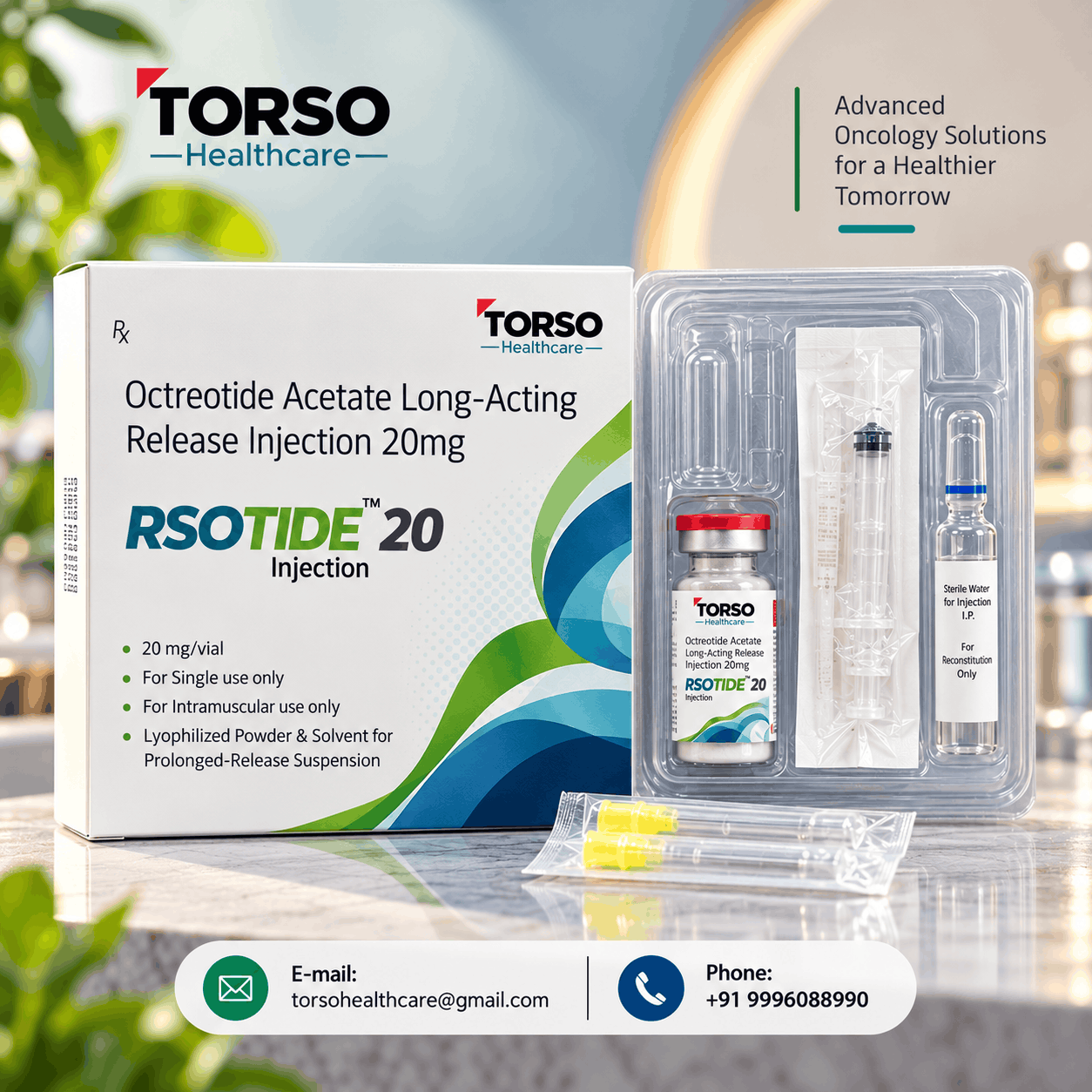
Octreotide Acetate Long-Acting Release Injection 20mg
₹20,000.00 Original price was: ₹20,000.00.₹18,000.00Current price is: ₹18,000.00.
| Specification | Details |
| Product Name | Octreotide Acetate Long-Acting Release Injection 20mg |
| Composition | Octreotide 20 mg, expressed as octreotide acetate, as a microsphere depot supplied with solvent |
| Packaging Size | Single dose kit, one vial with 2 mL solvent, adapter, and safety needle |
| Packaging Type | 6 mL glass vial with 3 mL prefilled solvent syringe, vial adapter, and safety needle |
| Brand Name | RSOTIDE 20 Injection |
| Form | Powder and diluent for suspension for injection |
| Strength | Octreotide 20 mg per vial, also made as 10 mg and 30 mg |
| Shelf Life | 36 months |
| Usage | Acromegaly, and symptom control in metastatic carcinoid tumors and VIPomas, as named in approved labeling |
| Route of Administration | Deep intramuscular, gluteal only, once every 4 weeks |
| Storage | Refrigerated at 2 to 8°C, protected from light, do not freeze |
| Certification | WHO-GMP, ISO, DCGI |
| Supply & Export | Available for the domestic and international markets |
| Manufacturer Name | Torso Healthcare |
| Country of Origin | Baddi, Himachal Pradesh (Made in India) |
Octreotide Acetate Long-Acting Release Injection 20mg
₹20,000.00 Original price was: ₹20,000.00.₹18,000.00Current price is: ₹18,000.00.
| Specification | Details |
| Product Name | Octreotide Acetate Long-Acting Release Injection 20mg |
| Composition | Octreotide 20 mg, expressed as octreotide acetate, as a microsphere depot supplied with solvent |
| Packaging Size | Single dose kit, one vial with 2 mL solvent, adapter, and safety needle |
| Packaging Type | 6 mL glass vial with 3 mL prefilled solvent syringe, vial adapter, and safety needle |
| Brand Name | RSOTIDE 20 Injection |
| Form | Powder and diluent for suspension for injection |
| Strength | Octreotide 20 mg per vial, also made as 10 mg and 30 mg |
| Shelf Life | 36 months |
| Usage | Acromegaly, and symptom control in metastatic carcinoid tumors and VIPomas, as named in approved labeling |
| Route of Administration | Deep intramuscular, gluteal only, once every 4 weeks |
| Storage | Refrigerated at 2 to 8°C, protected from light, do not freeze |
| Certification | WHO-GMP, ISO, DCGI |
| Supply & Export | Available for the domestic and international markets |
| Manufacturer Name | Torso Healthcare |
| Country of Origin | Baddi, Himachal Pradesh (Made in India) |
A depot that does nothing for a fortnight sounds like a fault. For Octreotide Acetate Long-Acting Release Injection 20mg, it is designed to behave, and the approved labeling writes the gap straight into the dosing instructions. Serum octreotide takes time to climb after the first intramuscular dose, so carcinoid and VIPoma patients switching across from the subcutaneous injection keep taking it for at least two more weeks. Stop it early, and symptoms can come back. That single rule shapes how a distributor stocks this product, how a clinic schedules it, and how a buyer reads two quotes that look identical on paper.
Why the First Two Weeks Need a Second Product
Most depot injections replace the daily version from the first dose. This one overlaps with it. The labeling is specific about the reason, which is the need for serum octreotide to reach therapeutically effective levels, and equally specific about the consequence of ignoring it: failure to continue the subcutaneous injections for that period may bring symptoms back. Some patients need three or four weeks of overlap rather than two.
| Patient group | Subcutaneous octreotide after the first depot dose | Depot dose named in the labeling |
| Acromegaly, already on the injection | May switch the day after the last subcutaneous dose | 20 mg every 4 weeks for 3 months, then review |
| Carcinoid syndrome | Continue the same subcutaneous dose for at least 2 weeks | 20 mg every 4 weeks for 2 months, then review |
| VIPoma | Continue the same subcutaneous dose for at least 2 weeks | 20 mg every 4 weeks for 2 months, then review |
| Dialysis or cirrhosis | As for the group above | Start at 10 mg every 4 weeks |
Acromegaly is the exception in the table, and it is worth understanding why rather than memorizing it. Acromegaly is treated as a slow chronic condition where a few days of lower drug levels change little. Carcinoid syndrome is not. Flushing and severe diarrhea return quickly when somatostatin coverage drops, which is why that group carries the overlap rule.
For anyone supplying this product, the commercial consequence is direct. A pharmacy or hospital that stocks only the 20 mg depot cannot start a carcinoid patient on therapy. The immediate-release ampoules have to sit on the same shelf, and a tender covering one without the other leaves a gap that the clinician discovers on day one. Distributors building a neuroendocrine range usually plan this alongside the cytotoxics they already carry, such as gemcitabine 200 mg vial.
Octreotide Acetate Long-Acting Release Injection 20mg Uses
Read the indications closely, because the wording does more work than it first appears. The approved list covers long-term maintenance in acromegaly for patients who responded inadequately to surgery or radiotherapy, or for whom neither is an option. For metastatic carcinoid tumors, the indication is long-term treatment of severe diarrhea and flushing episodes. For VIP secreting tumors, it is the profuse watery diarrhea. In those two settings, the labeled target is the symptom rather than the tumor itself, and any supplier page should say so plainly.
European labeling adds control of advanced midgut neuroendocrine tumors once a non-midgut origin has been excluded, along with TSH-secreting pituitary adenomas in defined situations. One condition runs through every one of the Octreotide Acetate Long-Acting Release Injection 20mg uses: the depot is meant for patients in whom the immediate release injection has already been shown to work and to be tolerated. It is a maintenance product, which is a different pattern from an acute oncology vial such as carboplatin 450 mg injection, and it explains why demand runs steady per patient rather than in bursts.
Cold Chain and the Thirty Minutes Before Injection
Picture a consignment reaching a clinic in Nagpur in May. The vial has held 2 to 8°C the whole way, the logger confirms it, and the nurse takes it out and prepares it at once because the patient is waiting. That last step is the error. The kit needs 30 to 60 minutes at room temperature before the suspension is made, and skipping it puts the dose outside the labeled preparation sequence even though the storage record is perfect.
| Stage | What the labeling requires | What does it mean on your side |
| Warehouse and transit | 2 to 8°C, protected from light, do not freeze | A validated cold chain and a logger in the box, not an ambient van |
| Day of the injection | May be kept below 25°C on the day of use | A short working window at the clinic, not a second storage condition |
| Before preparation | Stand at room temperature for 30 to 60 minutes | A dose prepared straight from the refrigerator is out of sequence |
| After mixing | Give immediately once the suspension is uniform | Nothing is prepared in advance for a later slot |
The preparation itself is short. Add the 2 mL of supplied diluent through the vial adapter, let the vial stand for about five minutes so the powder saturates fully, then swirl moderately until the suspension looks uniform and milky. Draw the whole contents into the syringe and give it straight away, inverting the syringe gently if it needs to stay even. European labeling allows the kit to sit below 25°C on the day of the injection, which gives a clinic a workable window without turning into a second storage condition.
Gluteal, Deep, and Never Into a Vein
The route here is narrower than most injectables, and the labeling does not mention it. The depot goes deep into the gluteal muscle every four weeks, and it must never be given intravenously or subcutaneously. European labeling puts the word never in capitals. Repeat doses alternate between the left and right gluteal muscles, and the deltoid is avoided.
The kit specifies a 1.5-inch 19-gauge safety needle. That is a wider bore than a routine intramuscular injection calls for, because what passes through it is a suspension of microspheres rather than a clear solution. Dosing intervals longer than four weeks are outside the labeling, which matters for appointment scheduling more than for stock planning, though the two meet at the month’s end when a clinic runs short.
Octreotide 20mg Injection Side Effects and Gallbladder Checks
The gut takes most of it. In the phase 3 acromegaly study of 261 patients, diarrhea was reported by 35.6 percent, abdominal pain by 28.7 percent, flatulence by 25.3 percent, headache by 15.3 percent, injection site pain by 13.8 percent, and nausea by 10.3 percent. A later study in patients new to treatment ran higher, with diarrhea at 47.4 percent. Most of this settles as therapy continues, and it is the predictable result of suppressing a hormone that regulates gut secretion.
Gallstones are the finding that changes clinical practice. New biliary abnormalities appeared in 52 percent of acromegaly patients and new cholelithiasis in 22 percent, while 24 percent of carcinoid patients developed new gallstones. European labeling, therefore, recommends ultrasound of the gallbladder before treatment and at roughly six-monthly intervals during it. Any training material shipped with the product should carry that schedule, because it is a monitoring requirement rather than a warning to read once.
Two more Octreotide Acetate Long-Acting Release Injection 20mg side effects belong on the same sheet. Blood glucose shifts in both directions, with hyperglycemia around 15 percent in acromegaly patients and 27 percent in carcinoid patients, so glucose is monitored when treatment starts and when the dose changes, and antidiabetic therapy is adjusted to match. Thyroid function is assessed at baseline and periodically during long-term use, with hypothyroidism reported in about 2 percent of acromegaly patients.
10 mg, 20 mg, or 30 mg: Which Pack to Stock
The 20 mg is the volume line, and the labeling is the reason rather than the market. Almost every patient starts there:
- Acromegaly switching from the subcutaneous injection starts at 20 mg every 4 weeks for 3 months, then the dose is reviewed.
- Carcinoid and VIPoma patients start at 20 mg every 4 weeks for 2 months on the same basis.
- Patients on dialysis or with cirrhosis start lower, at 10 mg every 4 weeks.
- The 30 mg covers patients whose response at 20 mg is incomplete after the review period.
A distributor carrying one strength carries 20 mg. A distributor carrying the full line holds 10 mg and 30 mg in smaller numbers for the two ends of that range. The pattern resembles other maintenance injectables more than it does acute hospital stock, and it is a useful comparison when planning a critical care injectables portfolio where turnover works differently.
Octreotide LAR 20mg Price in India and What It Signals
The Octreotide Acetate Long-Acting Release Injection 20mg price is MRP ₹ 18000 per kit. Presentation is what moves it, because the depot ships as a kit rather than a bare vial. The 6 mL vial, the prefilled solvent syringe, the vial adapter, and the safety needle all sit inside that figure, so a change to any one component changes the quote.
Refrigerated handling adds to it on every consignment, since the kit holds 2 to 8°C from the plant through to the clinic. Batch pricing then depends on the number of kits ordered. Send your monthly requirement for octreotide LAR 20 mg, with the kit format and the destination market, and the team will come back with current rates.
Octreotide LAR 20mg Manufacturer in India
Torso Healthcare is a WHO GMP-certified injectable manufacturer based in Baddi, Himachal Pradesh, supplying hospitals, distributors, and franchise partners in India and export markets, including oncology medicine manufacturing for partners building a specialty range. Buyers searching for an Octreotide Acetate Long-Acting Release Injection 20mg manufacturer in India tend to ask three questions in the same order: whether the depot is produced in-house, how release consistency is shown between batches, and what the cold chain commitment covers from dispatch to delivery.
Facility details, dossier support, and batch documentation from the pharmaceutical manufacturing facility are shared on request, along with standard third-party manufacturing terms.
Hospitals, distributors, and franchise partners sourcing Octreotide Acetate Long-Acting Release Injection 20mg in bulk, or planning their own label neuroendocrine range around it, can send their pack specification with the quantity, kit format, and destination market, and Torso Healthcare will reply with current rates and lead times.
Indications, switching rules, dosing, storage, preparation, and safety data on this page follow the Sandostatin LAR prescribing information and the European summary of product characteristics.
Frequently Asked Questions
Can the depot be used for acute bleeding or an emergency?
No. Some retail listings group the depot with uses that belong to the immediate release presentation, such as bleeding esophageal varices. The depot takes weeks to reach effective serum levels and must never be given intravenously, so acute indications sit with the short-acting injection, not this vial.
Why must subcutaneous octreotide continue after the first depot dose?
Because serum levels need time to build. The labeling directs carcinoid and VIPoma patients to continue the same subcutaneous dose for at least two weeks, and warns that stopping early may bring symptoms back. Acromegaly patients already on the injection may switch the day after their last subcutaneous dose.
Does the vial need a cold chain all the way to the clinic?
Yes. Storage is 2 to 8°C, protected from light, and the product must not be frozen. European labeling allows it to be kept below 25°C on the day of the injection only. Transit needs temperature monitoring, which is a standing cost on every consignment of this product.
How long before injection does the kit leave the refrigerator?
Thirty to sixty minutes. The kit stands at room temperature before the suspension is prepared, the vial rests for about five minutes after the diluent goes in, and the dose is given immediately once mixing produces a uniform milky suspension.
Is the 20 mg strength interchangeable with 10 mg or 30 mg?
No, and the three are not substitutes at the counter. The strength follows the patient, with 20 mg as the labeled starting dose for most, 10 mg for dialysis and cirrhosis patients, and 30 mg after an inadequate response at 20 mg. Substitution is a prescribing decision.
Can the kit be supplied under our own brand name?
Yes, subject to the product being in the current manufacturing range. Own label supply covers the brand name and carton artwork, with batch documentation including a certificate of analysis sent with each consignment.
Disclaimer: This page is intended for pharmaceutical businesses, trade buyers, and healthcare professionals as product reference information only. It is not an advertisement to the public, not medical advice, and not a recommendation for treatment. Octreotide long-acting release injection is a prescription medicine and must be prescribed and administered only under qualified medical supervision.
Third Party Enquiry Form
Filling our enquiry form is the first step towards getting in touch with us. It helps us understand your requirements better and enables us to provide you with a personalized solution.
Third Party Enquiry Form
Filling our enquiry form is the first step towards getting in touch with us. It helps us understand your requirements better and enables us to provide you with a personalized solution.
Related Products
Related products
-
Sale!
Octreotide Acetate Long-Acting Release Injection 30mg
₹22,000.00Original price was: ₹22,000.00.₹20,000.00Current price is: ₹20,000.00. -
Sale!
Pemetrexed 500 mg Inj
₹4,500.00Original price was: ₹4,500.00.₹4,000.00Current price is: ₹4,000.00. -
Sale!
Pemetrexed 100mg Injection
₹4,300.00Original price was: ₹4,300.00.₹3,800.00Current price is: ₹3,800.00. -
Sale!
Doxorubicin 50mg (Doxorubicin Hydrochloride Injection IP 50mg)
₹4,100.00Original price was: ₹4,100.00.₹3,000.00Current price is: ₹3,000.00.