
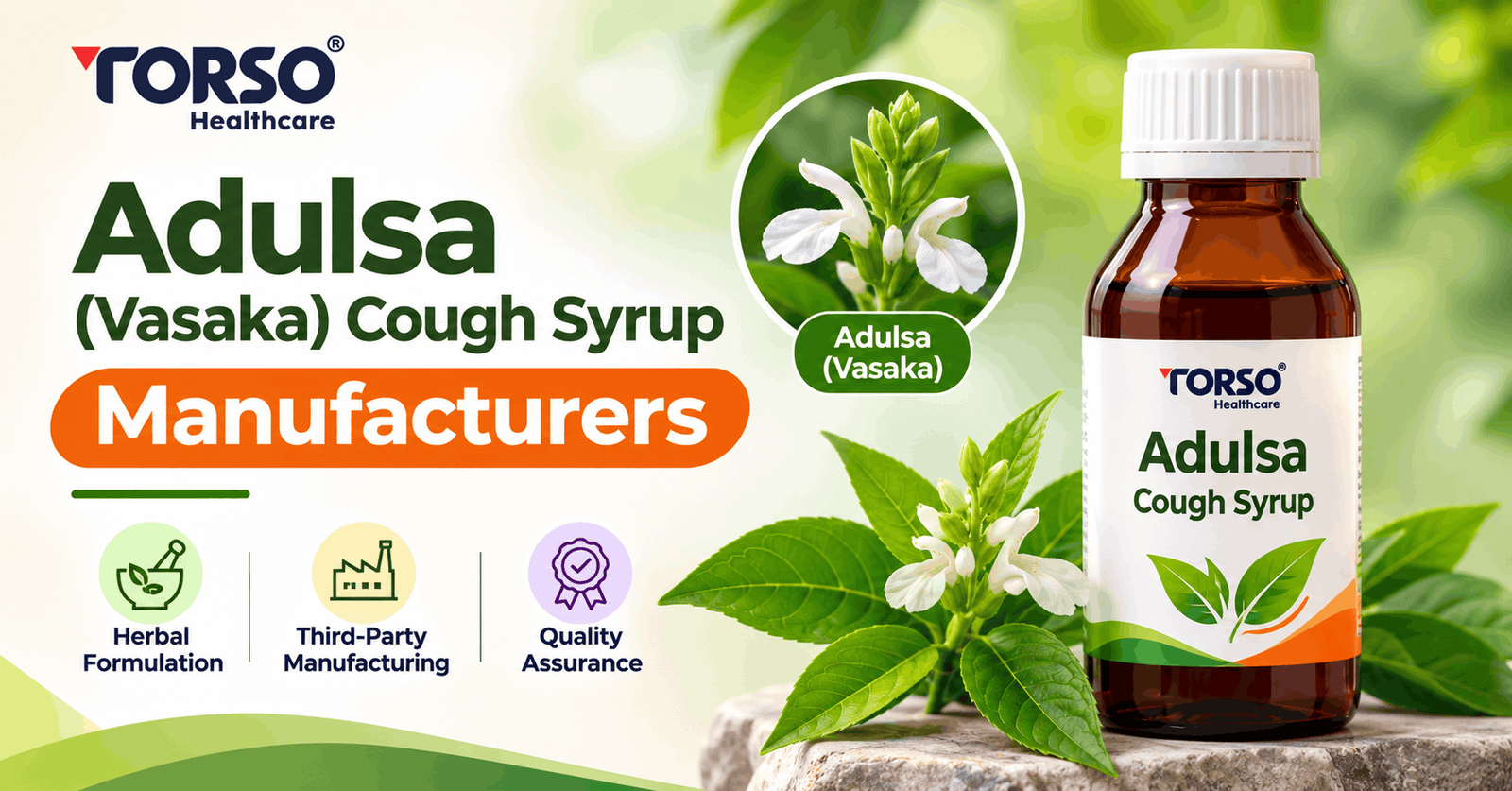
Most adulsa cough syrup manufacturers will send you a price per bottle within a day. Far fewer will tell you how much adulsa is actually in that bottle, and the published label data shows exactly why that gap matters.
This article covers what the directory listings leave out. Where adulsa sits in modern respiratory medicine, why two syrups at the same MRP can declare twelve times different herb content, how the extraction method decides potency, which companies already sell it, and what belongs in a manufacturing brief.
Adulsa content is invisible in the price. Ask for the declared quantity per 5 ml and the extraction method before you compare a single quote.
What is adulsa, and why is it in almost every Ayurvedic cough range?
Adulsa is Justicia adhatoda, cataloged in older literature as Adhatoda vasica and known as vasaka in Sanskrit, adusa in Hindi, and Malabar nut in English. Ayurvedic and Unani practices have used the leaf for cough for centuries.
The leaf carries quinazoline alkaloids, chiefly vasicine, with vasicinone alongside it. Analytical literature identifies vasicine as the key phytochemical, with bronchodilatory, antioxidant, and anti-inflammatory activity. Research outlining the bronchodilatory action of vasicinone dates back to a 1959 Indian study.
Here is the part almost no supplier mentions, and it is worth knowing before you write a product brief.
Boehringer Ingelheim developed bromhexine from vasicine in the late 1950s, and it reached the market as Bisolvon in 1966. Ambroxol, introduced in the late 1970s, is a semi-synthetic metabolite of bromhexine. So if your allopathic range already carries a bromhexine or an ambroxol syrup, you are selling a chemical descendant of the same plant that goes into your Ayurvedic one.
That shared ancestry is useful commercially. It gives a distributor a straight answer when a chemist asks why an Ayurvedic cough syrup belongs next to the mucolytics on the shelf.
Adulsa is Justicia adhatoda, also called vasaka. Its alkaloid vasicine was the starting point for bromhexine, and ambroxol is a metabolite of bromhexine, so two mainstream mucolytics trace back to this plant.
Why do two adulsa syrups at the same MRP declare different amounts of adulsa?
Because the declared herb quantity is a formulation decision rather than a function of price, and nothing obliges brands to express it on the same basis.
Five products currently listed on Indian pharmacy platforms, with the figures their own listings carry:
| Brand | Manufacturer | Pack | MRP | Declared adulsa |
| Adulsa Cough Syrup | Torso Healthcare | 100 ml | Rs. 78 | raw herb and standardized extract |
| Yogi Adulsa Cough Syrup | Yogi Ayurvedic Products, Nashik | 100 ml | Rs 79.69 | Adhatoda vasica 3,000 mg |
| Adusol Syrup | Ajanta Medicals, Goa | 100 ml | Rs 79.69 | Adulsa 250 mg |
| Dabur Honitus Adulsa | Dabur India, Baddi | 100 ml | Rs 99.00 | Adhatoda vasica leaf 375 mg per dose |
| Himalaya Vasaka Syrup | Himalaya Drug Company | 200 ml | Rs 155.00 | Adulsa 83 mg |
| Sandu Vasa Cough Syrup | Sandu Pharmaceuticals | 200 ml | Rs 159.38 | Not quantified on listing |
The prices mentioned above were checked on pharmacy listings in November 2026 and are subject to change. Verify the current MRP.
Look at the first two rows. Yogi and Adusol carry an identical MRP of Rs 79.69 for a 100 ml bottle. One declares 3,000 mg of Adhatoda vasica, the other 250 mg of Adulsa. Dabur Honitus, at Rs 99 for the same bottle size, declares 375 mg per dose, while Himalaya declares 83 mg in a 200 ml pack, and Sandu does not quantify it at all.
Those numbers are not directly comparable, and that is precisely the finding worth acting on. Labels express herb quantity per 5 ml, per 10 ml, or per stated dose, and some declare the raw drug charged into a decoction rather than the extract that ends up in the bottle. A 3,000 mg figure almost certainly refers to raw herb input, not delivered extract.
Before benchmarking anything, do two things. Normalize every figure to a per 5 ml basis, and read it off the physical carton rather than a marketplace listing. Then ask the manufacturer in writing whether the number refers to raw herb or to extract.
What the table does establish without ambiguity is that adulsa cough syrup MRP tells you very little about how much adulsa you are buying. A cheaper quote is not evidence of a thinner formula, and a premium price is not evidence of a richer one. Ask adulsa cough syrup manufacturers to quote against a stated composition rather than a bottle size, and the comparison becomes meaningful again.
Two 100 ml adulsa syrups at an identical Rs 79.69 MRP declare 3,000 mg and 250 mg of the herb. Normalize to a per 5 ml basis and confirm raw herb versus extract before comparing any quote.
How does the preparation method change what ends up in the bottle?
More than most buyers expect. Published analysis of Adhatoda vasica leaf juice found vasicine content varying by more than twenty-five times across six standard preparation methods.
Researchers quantified total alkaloids and vasicine across six preparation routes for the same leaf material:
| Preparation Method | Juice Yield per 100 g Leaf | Vasicine (mg/ml) |
| Traditional heated bolus, then squeezed | 25 ml | 5.64 |
| Steamed fresh leaf, no added water | 25 ml | 3.46 |
| Dry leaf powder macerated 24 hours in water | 50 ml | 1.92 |
| Hand-squeezed after stone mortar trituration | 14 ml | 1.03 |
| Steamed fresh leaf with 100 ml water added | 105 ml | 0.33 |
| Ground in a mixer with 100 ml water added | 160 ml | 0.20 |
The traditional heated bolus route delivered 5.64 mg/ml of vasicine. Grinding leaf in a mixer with added water delivered 0.20 mg/ml. Both outputs can be described on a label as leaf juice, and both would be accurate.
Notice the pattern in the middle column. The methods that produce the most liquid produce the weakest liquid. A manufacturer optimizing for yield per kilogram of leaf is, without doing anything improper, optimizing away the active content.
Capable adulsa cough syrup manufacturers expect to be asked about this, so four specifications belong in your brief, and none of them should surprise a serious supplier:
- Whether the input is fresh leaf juice, dry leaf powder, or a standardized extract.
- The extract ratio if an extract is used, written as a figure rather than a description.
- Whether the extract is standardized to vasicine and, if so, to what percentage.
- The quantity per 5 ml is declared on the carton rather than per dose.
A supplier running proper herbal medicine production will have these answers on file. A trading house reselling a batch made by someone else will not.
Vasicine content in leaf juice ranges from 5.64 mg/ml to 0.20 mg/ml depending on the preparation method, and the highest-yielding methods yield the weakest product. Specify extract ratio and vasicine standardization in writing.
Which companies make adulsa cough syrup in India?
Three distinct groups, and the one you approach should follow from what you are trying to do.
Searches for an adulsa cough syrup company name usually come from one of two places. A buyer checking who actually makes a product they picked up, or a distributor hunting for a supply partner. The answer differs for each.
National Ayurvedic houses
Dabur, Himalaya, and Sandu Pharmaceuticals all carry an adulsa or vasaka syrup under their own brand. They have distribution reach and recall, and they will not make a product under your label.
Regional Ayurvedic manufacturers
Yogi Ayurvedic Products in Nashik and Ajanta Medicals in Goa are examples of established regional units with their own brands. Pharmacy platforms also list adulsa syrups from Shreeja, Rajson, Balaji, Amrut, Ayusas, SJOA, and Inducare Pharma, as well as Pitambari in Maharashtra. Some of these units take contract work, and some do not, so it is worth asking directly.
Third-party and contract manufacturers
These units make under your brand and your label. Most Adulsa cough syrup manufacturers working on this basis will hold an Ayurvedic drug license covering liquid orals, and will already be making several cough formulas for other brand owners. Torso Healthcare supplies on this basis through contract batch production and area-wise franchise supply.
Which Adulsa brands are worth benchmarking against?
Benchmark on label data rather than on brand size, because the two do not track together. Dabur declares a full multi-herb composition with quantities, which makes it the easiest product to compare a proposed formula against. Himalaya and Sandu are useful reference points for 200 ml packaging and pricing. Yogi and Adusol show what the competitive 100 ml price band looks like.
None of that ranks the products on quality. Declared composition and clinical performance are different questions, and a label comparison answers only the first.
National houses sell their own brands and will not private label. Regional units may or may not take contract work. Third-party manufacturers make under your label, and label data beats brand size when benchmarking.
Which license does an adulsa cough syrup need?
An Ayurvedic drug license, and which route it takes depends on whether your formula is classical or proprietary. That single question decides your timeline.
Schedule 1 of the Drugs and Cosmetics Act, 1940 lists the authoritative Ayurvedic texts, around 55 books. A formulation made exactly to a recipe in one of those texts is a classical medicine. Vasavaleha and Vasarishta are the classical adulsa-based preparations.
Anything else is a patent or proprietary Ayurvedic medicine. Add tulsi, mulethi, honey, and haldi in quantities of your choosing. The product requires its own marketing authorization from the state drug licensing authority, supported by a rationale for the combination. The full picture sits in ayurvedic licensing requirements.
Check the five products in the table earlier. Each is a multi-herb formula with company-selected quantities, making them proprietary rather than classical. Nearly every branded Adulsa cough syrup on the market sits in this category.
Three practical consequences for a buyer:
- A classical formula can usually be launched faster, because the composition is already established in text.
- A proprietary formula needs its own product permission, so build approval time into your launch date rather than your reorder date.
- An Adulsa cough syrup manufacturing company must hold the Ayurvedic license itself. A marketing company with a good website may be two layers from the factory, so check that the license holder name matches the party quoting you.
Ayurvedic manufacturing also sits under its own GMP schedule rather than the allopathic one, which is covered in more depth in our guide to Ayurvedic cough formulation supply.
A text-exact formula is classical and launches faster. Any branded multi-herb Adulsa syrup is proprietary and needs its own product permission from the state licensing authority.
How to Brief Adulsa Cough Syrup Manufacturers
The sequence below front-loads the formulation questions, because changing a formula after artwork is printed costs more than any price negotiation will save. The wider cough syrup buyer checks apply on top of these.
- Decide classical or proprietary first, since it sets your approval timeline and narrows the list of units that can quote.
- Fix the adulsa input form: fresh juice, dry powder, or standardized extract, and state the extract ratio if applicable.
- Fix the declared quantity per 5 ml, and confirm in writing whether it refers to raw herb or to delivered extract.
- Decide the supporting herbs and their quantities. Tulsi, mulethi, kantakari, and honey are the common partners, and each one changes both the cost and the permission file.
- Choose sugar-based or sugar-free. Sugar-free widens the diabetic segment and changes the preservative system, so raise it early rather than at the trial batch.
- Fix pack size. The 100 ml bottle is the competitive retail unit, with the 200 ml serving the family and repeat-purchase segment.
- Ask for the license copy, the product permission, and a finished product specification before artwork. Check the license holder name against the quoting party.
- Agree on minimum order quantity, lead time from artwork approval, and the batch documentation you will receive.
Units already running syrup bottling capability at volume will work through this list quickly. Treat hesitation at step three as the signal it is.
Settle input form, declared quantity per 5 ml, and classical versus proprietary before artwork. A formula change after printing costs more than any price negotiation returns.
Frequently Asked Questions
Is adulsa the same as vasaka?
Yes. Adulsa is the Marathi and common Indian name; vasaka or vasa is the Sanskrit name; adusa is used in Hindi; and the botanical name is Justicia adhatoda, listed in older literature as Adhatoda vasica. Labels use these names interchangeably, so a product called Vasaka Syrup and one called Adulsa Syrup may contain the same herb.
What is a typical Adulsa cough syrup MRP in India?
Listed products cluster around Rs 80-99 for a 100 ml bottle and Rs 155-160 for a 200 ml bottle, based on pharmacy platform listings. Treat that band as a positioning guide rather than a cost indicator, because declared herb content varies widely within it.
Can an allopathic unit make Adulsa cough syrup?
Not under its allopathic license. Adulsa cough syrup is an Ayurvedic medicine and needs an Ayurvedic drug license covering liquid orals. A company may hold both licenses, often at separate premises or separate sections, but one does not substitute for the other.
Does more declared Adulsa mean a better syrup?
Not reliably, and this catches experienced buyers out. A high figure may describe raw herb charged into a decoction rather than the alkaloid content delivered in a 5 ml dose. A standardized extract declaring a lower weight but a stated vasicine percentage is more informative than a large raw herb number with no standardization behind it.
Is adulsa cough syrup safe for children?
Many Ayurvedic cough syrups are marketed for paediatric use, but dosing and suitability depend on the specific formulation and the age of the child, and some supporting ingredients are not intended for infants. Follow the label and treat a qualified practitioner as the decision maker rather than the carton. If you are building a paediatric cough range, confirm the age indication with your manufacturer in writing before artwork.
Can I launch my own adulsa brand without a factory?
Yes, through third-party manufacturing or a private label Ayurvedic supply arrangement. You hold the brand and the marketing, and the manufacturer holds the Ayurvedic license and the product permission. You will still need your own sales and distribution licenses wherever you sell.
Judging a Quote Properly
Adulsa is an unusually well-documented herb to build a product around. The alkaloid has been identified, analytical methods exist, preparation variables are published, and five competitor labels sit on pharmacy sites waiting to be read. Very few Ayurvedic ingredients give a buyer that much to work with before the first sample arrives.
Use it. Ask for the per-5 ml figure, ask whether it is raw herb or extract, ask for the vasicine standardization, and ask which licensing route the product will take. Four questions, and they separate a serious quote from a cheap one faster than any factory visit.
Shortlisting based on those answers, the field of Adulsa cough syrup manufacturers worth a sample batch narrows quickly.
Launch Your Own Adulsa Cough Syrup
Torso Healthcare manufactures Ayurvedic cough formulations under your brand, with declared composition and batch documentation. Send your target formula and pack size for a quote.