

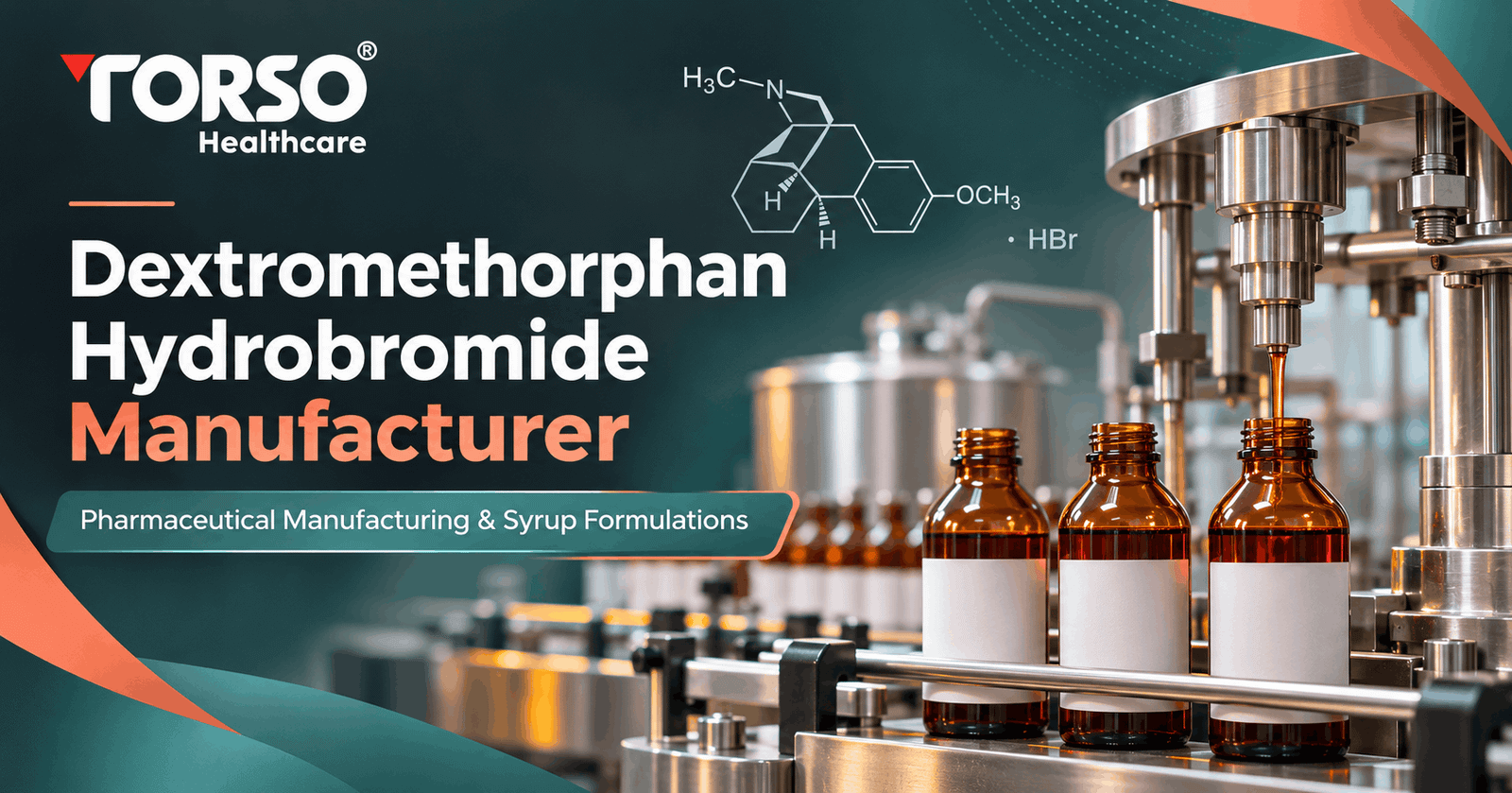
Searching for a dextromethorphan hydrobromide manufacturer returns two completely different kinds of companies on the same page, and most buyers do not notice until they are three emails into the wrong conversation.
One group sells the raw active ingredient by the kilogram to formulators. The other makes finished syrup in bottles under your brand. This article separates the two, covers what the October 2025 regulatory noise actually changed, sets out the strengths and combinations used in India, and gives you the questions that matter for each route.
Decide first whether you need bulk API or finished syrup. The suppliers, the paperwork, and the minimum orders have almost nothing in common.
Do you need an API supplier or a formulation manufacturer?
They are different industries that happen to share a search term.
An API maker runs chemical synthesis and sells powder in drums, usually by the kilogram, to companies that will turn it into a product. A formulation manufacturer buys that powder, makes syrup, fills bottles, and prints your label. Almost no company does both well.
Indian dextromethorphan hydrobromide manufacturers fall cleanly into one camp or the other, so the first question worth asking any of them is which one they are.
| API manufacturer | Formulation manufacturer | |
| What you buy | Bulk dextromethorphan hydrobromide powder | Finished syrup in bottles under your brand |
| Typical unit | Kilograms | Bottles, usually thousands per SKU |
| Key document | Drug Master File, COA, residual solvent data | Manufacturing license, product permission, batch records |
| Facility | Chemical synthesis plant | Liquid oral section |
| Who buys | Formulation companies | Brand owners, PCD and distributors |
| Torso Healthcare | Yes | Third-party and PCD supply of finished syrup |
If you need the API
Indian dextromethorphan hydrobromide API manufacturers are concentrated in the chemical belts of Maharashtra and Gujarat, and most list through B2B directories and sourcing platforms rather than running their own demand generation. Ask for the Drug Master File reference, the certificate of analysis against the pharmacopoeial monograph you need, residual solvent data, and the regulatory filings the material is already covered by.
Price per kilogram moves with order size and with the monograph you specify, so quote against a stated specification rather than the molecule name alone.
If you need finished syrup
You are looking for a liquid oral manufacturer with the product permission for your exact composition. The questions are about licenses, batch documentation, and excipient testing rather than about synthesis. A liquid formulation facility with existing cough syrup permissions will move much faster than one starting from nothing.
API manufacturers sell bulk powder by the kilogram against a Drug Master File. Formulation manufacturers sell finished bottles against a product permission. Decide which you need before sending the first inquiry.
Is dextromethorphan hydrobromide banned in India?
No. The molecule is not banned, and the claim that it was is one the government has publicly corrected.
On 8 October 2025, the Press Information Bureau Fact Check Unit called a widely shared claim that dextromethorphan hydrobromide cough syrups had been banned misleading. The accurate position is narrower: the Central Drugs Standard Control Organization has restricted certain fixed-dose combinations containing the ingredient, principally those pairing it with antihistamines and decongestants, with use restricted in young children and products marked as not for children below four years.
The government confirmed again on 13 October 2025 that the ingredient remains permitted in some cough syrup formulations while certain combinations stay restricted.
Two things are worth separating carefully, because the news cycle ran them together and buyers are still confusing them.
- The contaminated syrup deaths of late 2025 involved diethylene glycol in the liquid base. That is an excipient contamination failure and has nothing to do with which active ingredient the syrup carried.
- The separate paediatric restriction on anti-cold combinations came from a Drugs Controller General of India letter dated 18 December 2023 covering the chlorpheniramine maleate and phenylephrine fixed dose combination, which does not contain dextromethorphan at all.
So a buyer planning a dextromethorphan product in 2026 is working with a permitted Schedule H molecule, subject to combination level restrictions and paediatric limits. What you must confirm is whether your specific composition is among the approved ones, because that is where the restriction sits. Any dextromethorphan hydrobromide manufacturer quoting you should be able to state that status in one sentence.
Dextromethorphan hydrobromide is not banned in India. Certain fixed dose combinations with antihistamines and decongestants are restricted, and paediatric use is limited. Confirm your exact composition rather than the molecule.
Which strengths and combinations does the Indian market use?
A narrow set of strengths, and the combination you choose matters far more than the strength does.
Dextromethorphan is a non-opioid antitussive that acts centrally on the cough center in the medulla, and Indian listings classify it as a Schedule H prescription drug approved by the DCGI. Syrup strengths in circulation are 5, 7.5, 10 and 15 mg per 5 ml, with 10 mg per 5 ml the most common paediatric and general presentation.
| Presentation | Strength | Note |
| Single ingredient syrup | 10 mg per 5 ml | Most common presentation |
| Single ingredient syrup | 5, 7.5 or 15 mg per 5 ml | Less common, used for specific dosing |
| Combination syrup | Varies by partner molecule | Combination level restrictions apply |
| Tablet or capsule | 15 mg | Adult presentation |
Three points a brand owner should hold on to:
- Schedule H means prescription only, so the carton needs the prescription warning and your distribution has to run through the prescription channel.
- Standard references note it is not for over the counter use in children below four years, so paediatric positioning needs care and the label has to reflect it.
- The molecule carries recognized dependence and abuse potential with prolonged or excessive use, which is part of why it sits on Schedule H and why combination products attract regulatory attention.
That last point is a commercial consideration as much as a clinical one. A brand owner building a long-term cough portfolio should expect continuing scrutiny of this category rather than a settled rulebook.
Indian dextromethorphan syrups run at 5 to 15 mg per 5 ml, with 10 mg per 5 ml most common. It is a Schedule H prescription drug, not for OTC use under four years, with recognized abuse potential.
What should you check before choosing a dextromethorphan hydrobromide manufacturer?
Six documents, and the list differs depending on which of the two routes you are taking.
Checks for a formulation supplier
- The manufacturing license, with the license holder name matching the company quoting you.
- The product permission for your exact composition and strength, not for the category.
- Confirmation that your composition is not among the restricted fixed dose combinations.
- Batch-wise certificate of analysis for diethylene glycol and ethylene glycol on propylene glycol, glycerin, and sorbitol consignments.
- The water system qualification record and recent water test report.
- Revised Schedule M compliance status, or a registered upgrade plan with CDSCO.
Checks for an API supplier
- Drug Master File reference and the regulatory filings the material already supports.
- Certificate of analysis against the pharmacopoeial monograph you need, with residual solvent data.
- Manufacturing site details and current GMP certification.
A credible dextromethorphan hydrobromide manufacturer in India on either route will send these without a chase. Reluctance on the product permission question is the single most useful warning sign in this category, because that is exactly where the current restrictions bite.
For finished syrup, check license, product permission for the exact composition, combination status, glycol testing, and Schedule M. For API, check the Drug Master File, monograph compliance, and GMP certification.
How to Order a Dextromethorphan Syrup Under Your Brand
The regulatory questions come first here more than in most categories, because a composition that cannot be permitted makes everything downstream irrelevant.
- Fix the composition and confirm it is an approved one rather than a restricted fixed-dose combination.
- Fix the strength per 5 ml and the bottle size, commonly 60 ml or 100 ml.
- Confirm the manufacturer already holds a product permission for that composition, or budget for the approval time if not.
- Confirm the Schedule H labeling requirements are reflected in the artwork brief before anything goes to print.
- Confirm the paediatric age statement on the label matches the composition and current guidance.
- Ask for the glycol testing protocol on excipients and a sample certificate of analysis.
- Agree minimum order quantity, lead time from artwork approval and the batch documentation package.
- Confirm your own sale and distribution licenses cover a prescription product in every state you plan to sell in. Whether you go through contract manufacturing terms or a franchise territory model, that obligation stays with you.
Worth being clear on the split. A third-party contract manufacturer in India holds the manufacturing license and the product permission for the product it makes. The sale and distribution licenses, and the responsibility for selling a prescription medicine correctly, sit with the brand owner.
Confirm the composition is approved before anything else, then product permission, Schedule H artwork and the paediatric age statement. Commercial terms come last.
Frequently Asked Questions
Is dextromethorphan available over the counter in India?
It is classified as a Schedule H prescription drug, so it should be dispensed against a prescription. Enforcement at the retail level varies, but your labeling, packaging, and distribution obligations follow the schedule rather than the practice you observe at a counter.
Can I make a dextromethorphan combination syrup?
Only if that specific combination is approved. CDSCO has restricted certain fixed-dose combinations pairing dextromethorphan with antihistamines and decongestants, so the answer depends entirely on the partner molecules and their quantities. Ask the manufacturer to confirm the status of your exact composition in writing before you commit to artwork.
What is the difference between dextromethorphan and codeine in a cough syrup?
Dextromethorphan is a non-opioid antitussive while codeine is an opioid, and they sit under different regulatory controls in India. Codeine containing preparations carry tighter restrictions. Both suppress cough centrally, but the control regime, the record-keeping, and the diversion risk profile differ substantially, which is why most new brands avoid codeine.
Do API manufacturers supply small quantities for trial batches?
Many will, though the price per kilogram at trial quantity bears little relation to commercial pricing. If you are working with a formulation manufacturer, they usually source the API themselves, and you never deal with it directly, which is simpler. Ask whether API sourcing sits with you or with them before you approach any dextromethorphan hydrobromide API manufacturer in India directly.
How long does product permission take for a new composition?
It depends on the state authority and on whether the composition is already approved elsewhere. An existing permitted formula at the unit is immediate, while a new composition needs its own file. In this category, assume longer rather than shorter, because combination cough products attract closer review than most.
Is the market for dextromethorphan syrup shrinking?
The category is under more scrutiny than it was, which is different from shrinking. Restrictions have landed on specific combinations and on paediatric use rather than on the molecule, and the single ingredient presentation remains permitted. Plan for a regulatory environment that keeps moving rather than one that has settled.
Two Routes, One Search Term
The confusion in this category is structural. A bulk chemical supplier and a bottle filler both rank for the same words, and the gap between what they sell is as wide as the gap between a steel mill and a car dealer.
Work out which one you need, then ask that route its own questions. For API, the Drug Master File and the monograph. For finished syrup, the product permission and whether your exact composition sits inside the current restrictions.
Approach it that way, and picking a dextromethorphan hydrobromide manufacturer stops being a guess and becomes a short document review.
Planning a Dextromethorphan Syrup?
Send Torso Healthcare your composition and strength. You will receive the permission status, the labeling requirements, and a quote based on a full specification.